
Vacuum Suction Cup Safety Mechanisms: The Physics Behind the Vacuum Indicator
Introduction: From “Falling Anxiety” to Physical Predictability
In the high-stakes world of automotive rigging and industrial glass handling, equipment failure is not a statistical probability — it is an unacceptable outcome. Whether you are mounting a RED KOMODO on a Porsche 911 moving at 80mph or hoisting a 500kg architectural panel, the margin for error is nonexistent.
The industry often misunderstands the vacuum indicator on a pump plunger as a simple “Go/No-Go” sticker. It is not. It is a precision-engineered mechanical manometer that acts as a real-time contract between atmospheric pressure and the vacuum seal. True safety does not come from “strong suction”; it comes from the visualization of risk and the mechanical honesty of your equipment.
The Core Warning Logic: Differential Pressure (ΔP) vs. Spring Balance
To trust the tool, one must understand the math. The holding force of any vacuum cup is defined by the fundamental physics equation:
F = ΔP × AWhere F is Holding Force, ΔP is the pressure difference between the atmosphere and the cup’s interior, and A is the effective surface area.
The Superhobby Co., Ltd. vacuum indicator operates as a pure spring-balance mechanism. It does not rely on batteries or electronics, which can fail under the high-frequency vibrations of a moving vehicle. Inside the pump, a calibrated spring exerts a constant outward force. When you pump the plunger, you evacuate air, creating a low-pressure zone (Pinternal).
As long as the atmospheric pressure (Patm) pushing against the plunger is greater than the spring’s resistance plus Pinternal, the plunger stays retracted. The moment the vacuum drops below the critical safety threshold (typically -17.5″ Hg or -59 kPa), the spring force overcomes the ΔP, physically driving the vacuum indicator into view. This is differential pressure mechanics in its rawest, most reliable form.
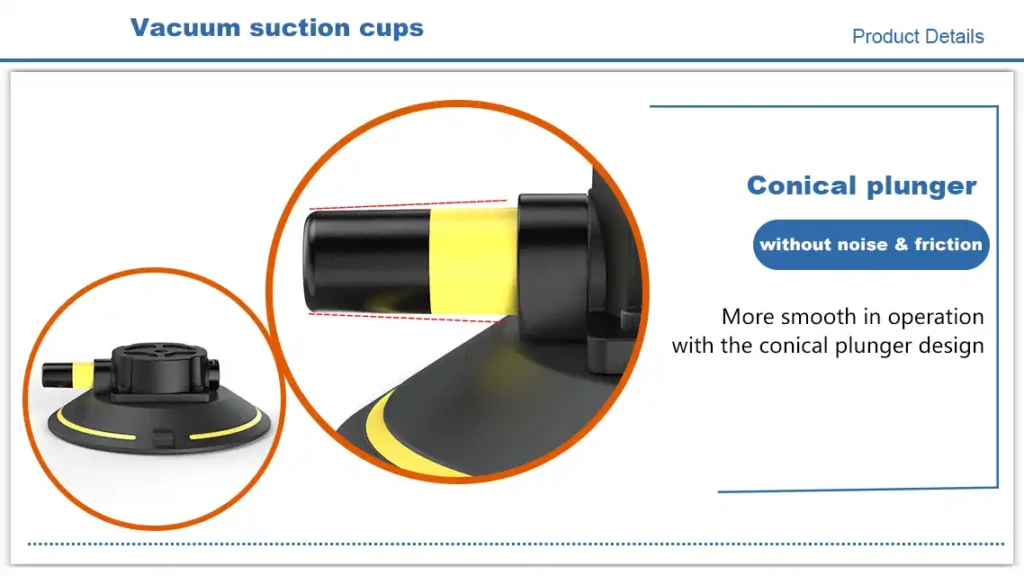
Cross-section of Superhobby vacuum indicator showing conical plunger and spring mechanism
Deep Dive: Quantifying the Safety Buffer
A common misconception is that seeing the vacuum indicator means immediate detachment. This is false, and understanding why is key to managing panic in the field.
The Vacuum Indicator is an Early Warning System, not a Failure Notification.
Take the Superhobby Co., Ltd. RC600 (6-inch) model as a case study in redundancy:
- Safe Working Load (SWL): 32kg (70lbs)
- Maximum Breakaway Load: >90kg (198lbs)
- Residual Hold at Warning: ~30kg
Even when the vacuum indicator is fully exposed, the system retains a partial vacuum capable of holding a significant percentage of its load. This Safety Buffer provides the operator with a critical time window — often minutes — to notice the warning and perform a “Re-pump” cycle, even while the rig is in motion. This aligns with ASME B30.20 standards, which dictate a minimum 2:1 safety factor for vacuum lifting devices.
Eliminating Feedback Latency: The Conical Plunger Optimization
In standard industrial pumps, a cylindrical plunger can suffer from “stick-slip” friction. If the lubricant dries out or dust enters the cylinder, the plunger may physically jam in the “Safe” position even when the vacuum has leaked away. This is a catastrophic False Negative.
The Superhobby Co., Ltd. Solution: Geometry over Friction.
We utilize a Conical Plunger (Tapered Design). By reducing the contact surface area between the plunger and the cylinder wall to a single sealing ring, we minimize the friction coefficient (μ).
- Cylindrical Plunger: High surface contact → High friction risk → Potential delayed warning.
- Conical Plunger: Minimal surface contact → Low friction → Instant response to ΔP changes.
Furthermore, the application of solid-state grease (rather than liquid oil) ensures that the lubrication remains viscous and effective across 50,000 actuation cycles, preventing the “drying out” phenomenon common in cheaper alternatives.
Physical Boundaries: Altitude Drift and Thermal Stress
Global operations require equipment that understands geography. The physics of vacuum changes with altitude.
The 5,000ft Effect
According to Pascal’s Law, atmospheric pressure drops as elevation rises. At 5,000 feet, Patm is significantly lower than at sea level. This means the “push” keeping the plunger retracted is weaker. A standard indicator might show a “False Positive” (vacuum indicator popping out) because the atmospheric force is insufficient to compress the spring, even if the cup is sealed perfectly. Superhobby Co., Ltd. pumps are calibrated to balance this, providing accurate feedback up to standard aviation transport altitudes.
Thermal Expansion & Rubber Chemistry
While metal pumps can withstand 100°C, the weak point is often the rubber pad. Cheap PVC pads become brittle at 0°C. Superhobby Co., Ltd. uses a proprietary EPDM-Silicon blend:
- Cold Resistance: Flexible down to -30°C (preventing micro-cracking).
- Heat Resistance: Stable up to 60°C (resisting deformation).
- Aging Test: 180 days of UV exposure with zero surface cracking.
Interface Mechanics: Shear Force & Surface Protection
In car mounting (Rigging), Shear Force (sideways slip) is the enemy. A cup that holds vertically might slide horizontally.
To combat this, the Superhobby Co., Ltd. cup features a 0.2mm Radiused Edge on the sealing lip. This specific geometry serves two purposes:
- Shear Resistance: It digs into the microscopic texture of the clear coat without damaging it, increasing the static friction limit.
- Ghosting Prevention: The rounded edge disperses stress, preventing the “suction rings” (ghosting) that can mar expensive automotive paint jobs.
Combined with our “Concave Line” internal air channels, the system allows for rapid air evacuation, achieving a secure lock in under 20 seconds.
Conclusion: Building Professional “Muscle Memory”
Safety is not a product; it is a protocol. The Superhobby Co., Ltd. vacuum cup, verified by TUV Rheinland testing procedures, transforms the vacuum indicator from a source of anxiety into a tool of control.
For the professional grip, the rigger, and the factory automation engineer, the goal is to build a muscle memory: See the vacuum indicator, Pump It. By choosing a system that prioritizes mechanical honesty, geometric optimization, and material science, you are not just buying a suction cup — you are buying the ability to predict the future of your payload.
Do not trust luck. Trust the physics.